
You walk into your kitchen first thing in the morning, and something feels… different. There’s a slight give under your feet near the sink that you don’t remember, a subtle sponginess that wasn’t there last week. Or perhaps you’ve noticed a hairline crack forming in a floor tile that seems to have appeared out of nowhere. These small changes are easy to dismiss, but they are often the first whispers of a larger issue lurking just below the surface: your subfloor.
As a Senior Remodeling Project Manager with over a decade of hands-on experience, I’ve seen how minor floor issues can escalate. Here in Luling, with many of our homes built on raised foundations or crawlspaces, the subfloor is particularly vulnerable to the effects of our humid climate and shifting soil. As the cooler, drier air of October sets in, it’s the perfect time to assess the health of your home’s foundation before the busy holiday season begins. Catching problems now can mean the difference between a straightforward carpentry repair and a major structural overhaul later.
Common Signs and Symptoms
The subfloor is the structural sheathing that sits atop your floor joists, providing a flat, stable surface for your finished flooring. When it begins to fail, the signs can range from subtle to severe. Here are some of the most common subfloor repair signs our teams encounter.
- Spongy or Bouncy Floors: This is often the first symptom homeowners notice. If walking across a room feels like you’re on a slight trampoline, it indicates that the subfloor has lost its rigidity or has detached from the floor joists below.
- A Noticeable Sag or Dip: Do you see a visible slope in the middle of a room? Does your furniture seem to tilt slightly? This is a clear indication of a significant structural problem, where the joists or the subfloor itself are no longer able to support the weight above them.
- A Localized soft spot in floor Luling homes: Unlike general bounciness, a soft spot is a concentrated area of weakness. These often appear in high-moisture areas like bathrooms (around toilets and tubs), kitchens (near sinks and dishwashers), and laundry rooms. Pushing down with your foot will reveal a distinct give in that one area.
- Persistent Squeaks and Creaks: While older homes naturally make some noise, new, loud, or persistent squeaking can signal that the subfloor is loose. The sound is often caused by the wood subfloor rubbing against the joists or the fasteners that have worked their way loose.
- Damaged Finished Flooring: Your finished flooring is only as stable as the subfloor beneath it. Look for cracked tiles, separating vinyl plank seams, or buckling hardwood floors. These are often symptoms of excessive movement and deflection in the subfloor, not a failure of the flooring material itself.
- Musty Odors from the Floor: A persistent, earthy, or musty smell that you can’t seem to clean away is a major red flag. This often points to moisture being trapped under the floor, leading to mold, mildew, and wood rot.
- Gaps Between the Floor and Baseboards: As a floor sags, it can pull away from the walls. If you see a new or widening gap between the bottom of your baseboard and the top of your flooring, it’s a sign that the floor level is dropping.
What Causes This Problem
Understanding the root cause of subfloor damage is critical for a lasting repair. Simply patching over a soft spot without addressing the underlying issue will only lead to more problems down the road. Here are the primary culprits we find.
Moisture Intrusion: This is, without a doubt, the number one cause of subfloor failure in our region. The plywood or OSB (oriented strand board) used for subflooring acts like a sponge. Once wet, it swells, weakens, and eventually rots. Common sources include:
- Slow plumbing leaks from toilets, shower pans, or supply lines.
- Appliance failures from dishwashers, washing machines, or refrigerators.
- High humidity and poor ventilation in a crawlspace, which allows moisture to condense on the underside of the subfloor.
Pest Damage: Termites, powder post beetles, and carpenter ants can compromise the structural integrity of your entire floor system. They tunnel through and consume the wood joists and subflooring, turning solid supports into a hollowed-out shell.
Foundation Settling: This is one of the key floor sagging causes in older homes. Many homes in the Luling area, particularly the brick ranch homes characteristic of the 1970s, have had decades to settle. If this settling is uneven, it puts immense stress on the home's frame, including the floor system, causing joists to twist or separate from their supports.
Inadequate Structural Support: Sometimes, the original construction is to blame. Joists may have been spaced too far apart, or an undersized beam might have been used for a long span. This might not have been an issue initially, but with the addition of heavy items like a granite countertop, a large kitchen island, or a cast-iron tub, the floor system becomes overloaded and begins to fail.
When to Call a Professional
While some homeowners are tempted by a DIY fix, subfloor issues are almost always a job for experienced professionals. The visible damage is often just the tip of the iceberg, and only a thorough inspection can reveal the true extent of the problem.
An isolated squeak might be fixed with a specialized screw, but anything involving moisture, sagging, or a soft spot requires a professional diagnosis. Attempting to patch a rotted section without understanding the cause of the moisture will result in a failed repair within a year or two.
When our technicians investigate a subfloor issue, we follow a detailed diagnostic process. Here is a simplified subfloor bounce repair checklist you can use to assess your situation before calling for help:
- Identify the Location: Is the bounce or soft spot near a water source like a bathroom, kitchen, or exterior wall?
- Determine the Scope: Is it a small, six-inch spot, or does it affect a multi-foot area or an entire room?
- Look for Related Signs: Are there any other symptoms present, like cracked tiles, musty smells, or visible water stains on the ceiling below?
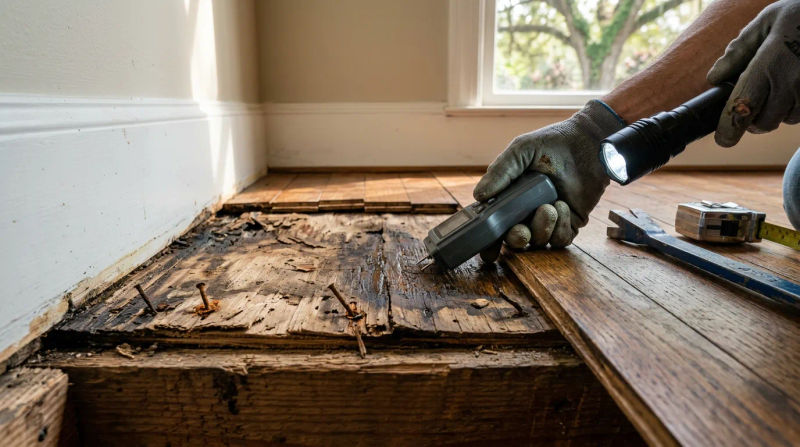
- Check Accessibility: If you have a crawlspace, can you safely look underneath the affected area? Caution: Be mindful of wiring, plumbing, and pests. Look for dark water stains, damaged wood, or fallen insulation.
If your assessment reveals widespread issues or any signs of moisture, it’s time to contact a qualified professional. A proper repair involves not just replacing the damaged wood but also identifying and rectifying the source of the problem, sistering weakened joists, and ensuring the new subfloor is properly integrated with the existing structure.
Conclusion
Your home's floors should feel solid and secure underfoot. Bounciness, sagging, and soft spots are not just minor annoyances; they are important subfloor repair signs that indicate your home's structure is compromised. In Luling, the combination of our climate and common construction styles from the 1970s makes our subfloors particularly susceptible to moisture and age-related issues.
By paying attention to these warning signs this fall, you can address the problem early, protecting your home and preventing a small repair from becoming a costly, large-scale renovation. Don't wait for the problem to get worse.
If you notice any of these signs, contact a local home remodeler for an inspection.